


File photo
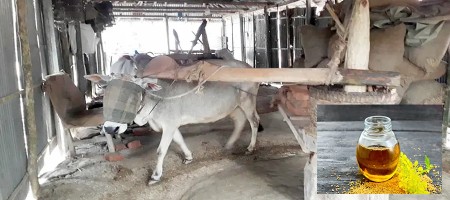
A year ago, Sujan Ali opened a shop selling mustard oil called 'Pabna Chashi Oil Mill' in Chandrima Housing in the capital's Mohammadpur area. He crushes mustard seeds and sells the oil using a machine installed in the shop. Earlier, this small businessman used to sell oil on the streets since 2016. He said that due to demand, mustard oil is now sold at every corner of the road. That is why he opened the shop. More than 50 liters of oil are sold daily. The number of regular customers is increasing day by day. Due to the increase in demand, about 10 oil crushing machines have now been started in this area.
Meanwhile, mustard production in the country is increasing due to the increase in demand and sales of oil. Production has doubled in just three years. Although it decreased in the fourth year, it is expected to increase again in the fifth year.
According to the Department of Agricultural Extension, mustard production in the country was 8 lakh 24 thousand metric tons in the last fiscal year 2021-22. Then, production increased to 1.163 million tons in the 2022-23 fiscal year and exceeded 1.6 million tons in the 2023-24 fiscal year. Although production doubled in three years, production decreased to 1.5 million tons in the 2024-25 fiscal year due to rain. However, the production target for the current fiscal year has been set at 1.7 million tons.
In addition to shops, people can now be seen selling oil by crushing mustard seeds in machines on various alleys and streets of the capital. One such seller is Khalek Mia from Natore, who sells oil in front of Mohammadpur Residential School from morning to noon, in the Shia Mosque area from noon to afternoon, and in the New Market area in the evening and at night. Khalek Mia said that he sells about 150 liters of oil every day at three places. In addition, he has his own oil mill in Keraniganj. He sells oil wholesale and retail there.
It is said that mustard oil is healthier than other oils and has better nutritional content. Accordingly, awareness among people is increasing day by day. As a result, the sale of mustard oil is increasing. Sellers buy mustard seeds during the season. Then they break them up and sell the oil throughout the year.
While talking to various people related to the sector, it was learned that the 'Increase in Oilseed Production' project of the Department of Agricultural Extension is playing a major role in increasing mustard production. Through this project, assistance is being provided to increase the production of oilseed crops in 250 upazilas of the country. This project aims to increase the production of oilseed crops by 15 to 20 percent.
In this regard, Sub-Project Director Md. Abdullah Al Mamun said, 'Agricultural land remains fallow during the period between paddy cultivation in the Aman and Boro seasons. We provide seeds, fertilizers, and pesticides to motivate farmers to cultivate mustard on such fallow land, so that farmers are interested in cultivating mustard.'
The yield of mustard rises in the period of 80 to 85 days between the two crops. Through the project, mustard cultivation has increased from 7 lakh hectares to 1.1 lakh hectares. However, about 1 million hectares of agricultural land in the country remains fallow between two crops, said the sub-project director. By cultivating mustard on these lands, oil production in the country can be further increased.
Talking to sellers, it was learned that the demand and sale of mustard oil in the country have been increasing since Corona. About three kilograms of mustard seeds are required to make 1 liter of oil. 300 and a half grams of oil and 600 and a half grams of kheil are obtained from 1 kilogram of seeds. And these kheil can be sold for 50 to 60 taka per kg. The price of one kilogram of mustard seeds is about 100 taka.
Currently, mustard oil sold by local small entrepreneurs is sold at a price of 240 to 280 taka per liter. And a 5-liter bottle is available for 1,150 taka. The price of half a liter of oil is 130 to 150 taka. However, the price of bottled brand oil is even higher, 300 to 340 taka per liter.
According to the Department of Agricultural Extension, the largest mustard cultivation in the country is in Sirajganj district. Then there are Tangail, Manikganj, Pabna, and Bogra districts. Agricultural officials say that mustard is now being cultivated in the Trishal Beel area of Mymensingh. These lands used to be fallow. Apart from this, mustard cultivation is also increasing in Dhamrai, a district adjacent to Dhaka.
According to the United States Department of Agriculture (USDA), the annual demand for edible oil in Bangladesh is about 3.2 million tons. And the per capita consumption of edible oil is 17 kg per year. 50 percent of this demand is met by palm oil. This oil is used more in the country because it is cheap. 28 percent of the demand is met by soybean oil. Mustard oil meets 19 percent of the oil demand. The remaining 3 percent is met through various oils.
A USDA report on the edible oil market in the country says that the demand for oil is constantly increasing as restaurants is increasing in the country. People are especially interested in mustard oil. The organization also believes that many farmers will turn to mustard production this time, as the price of potatoes is not getting any better. A USDA report mentions that the popularity of cashews produced from mustard is also increasing.
The major companies in the bottled or branded mustard oil market in the country include ACI, Pran, City, Square, Fresh, and Orion Group. These companies produce oil from local mustard as well as imported mustard. A small amount of mustard oil from the country is exported to Bahrain, Saudi Arabia, Qatar, and Malaysia.
Pran's Director (Marketing) Kamruzzaman Kamal told Prothom Alo, "We export mustard oil to Middle Eastern countries. Mainly, expatriate Bangladeshis buy this oil. Apart from that, people from India, Pakistan, and Asian countries living there also buy it."
Businessmen in this sector say that the branded mustard oil market in the country is now over Tk 1,000 crore. The mustard oil market is growing at an overall rate of 5 to 6 percent every year. However, officials of both organizations said that ACI has grown by 28 percent and Pran by 20 percent in the mustard oil business in the last year.
When asked, ACI Consumer Business President Mohammad Rezaul Islam said, "People are becoming aware. As a result, the demand for mustard oil is increasing. That is why we have come up with a new brand, "Aroma" with ACI Pure. Considering the health of people, we want to further increase the sales of mustard and rice bran oil. We want to bring different varieties of these oils.’
When asked about the difference between local traditional oil processing and industrial processing, Mohammad Rezaul Islam said, ‘There is no fundamental difference between both types of processes. However, the traditional method uses very old equipment. The oil is not completely refined there. So it cannot be called very hygienic. We extract and refine the oil. In this, the components of the oil remain intact.’
Source: Online/OFA






Comment Now